
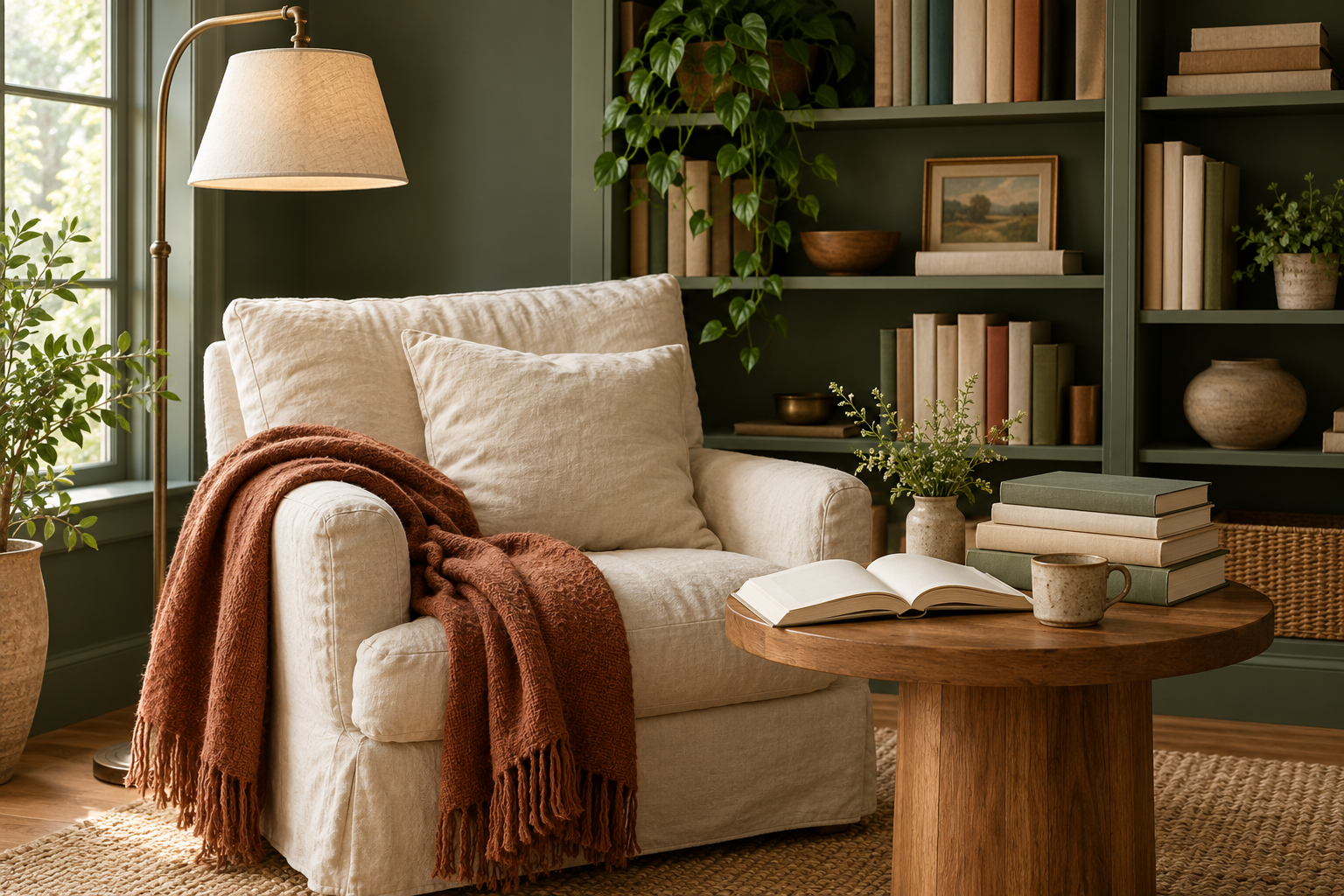
This week · A shelf with somewhere to begin
The best next book depends on what you want from the time you give it. This opening Bookshelf offers two routes into a better room, a pause for creative thought and a mystery for an evening when the room can wait. One design title arrived last month; the others are backlist choices. Begin with the decision or mood closest to your own, rather than treating four recommendations as another list to finish.
The New Design Rules · For decisions before the shopping cart
Emily Henderson and Jessica Cumberbatch Anderson’s The New Design Rules: How to Decorate and Renovate, from Start to Finish brings a practical brief to the shelf. The publisher describes coverage of paint, furniture arrangement, lighting and window treatments, alongside guidance on the professionals involved in a project. The 2022 hardcover is 336 pages; an ebook is also listed.
Our editorial judgment: put this first when a room refresh has turned into a chain of unresolved choices. Its documented range makes it a useful candidate for connecting the finish you like with the work that must happen around it. Read the relevant part with measurements and a written brief beside you. A broad design guide can help you ask better questions; local construction requirements and a contractor’s site-specific assessment still need their own answers.
The reservation is scope. Someone seeking only quick shelf-styling inspiration may prefer a narrower starting point. This is our planning choice for a reader who wants to make connected decisions.
- Reader fit: a thoughtful refresh or an early renovation brief.
- Format check: Clarkson Potter hardcover or ebook; examine the publisher sample before choosing.
Interiors · A recent release about the process behind a room
Amber Lewis’s Interiors: A Home Renovation and Interior Design Book was published by Clarkson Potter on September 29, 2026. The 304-page book presents nine homes, more than 200 images and a six-stage account of the studio’s project process. The publisher also describes notes on scale, artwork and working with a designer. Hardcover and ebook editions are listed.
Our editorial judgment: this is the pick for readers who collect attractive room pictures but want to understand how decisions become a finished space. The useful question to carry through a project tour is: which choices belong together? A paint color, furniture scale and lighting plan can look appealing separately while still needing to work as a group in your room.
The caveat is that a designer’s documented process is a perspective to examine, rather than a promise about your own budget or timeline. Use the photographs to identify qualities you want, then translate those qualities into a realistic brief.
- Reader fit: design enthusiasts curious about how projects develop.
- Format check: compare the sample on your intended screen if considering the illustrated ebook.
The Creative Act · For creative attention rather than another room makeover
Rick Rubin’s The Creative Act: A Way of Being turns toward the relationship between a person and creative work. Penguin Press positions it as a reflection on creativity beyond any single artistic output. The 2023 hardcover is 432 pages; the publisher also lists an ebook and a 5-hour, 45-minute audiobook.
Our editorial judgment: choose this when you want to reflect on how you approach making things, whether that means writing, music or a personal project. That is a different reading goal from learning a specific production technique. Try the publisher sample before committing if broad philosophical advice tends to frustrate you.
Critical context: Kitty Empire praised its perspective while noting familiar advice (The Guardian, January 10, 2023).
The publisher describes it as a New York Times bestseller. That is an attributed sales distinction, not a statement about its position on this week’s chart. Our selection rests on its fit for a reflective reading session.
- Reader fit: creative reflection and a change of mental pace.
- Commitment check: compare a print sample with the audio sample before choosing a format.
The God of the Woods · A longer mystery for an uninterrupted evening
Liz Moore’s The God of the Woods begins with a teenager missing from an Adirondack summer camp in 1975, years after her brother disappeared. Riverhead’s description places family secrets and the divide between a wealthy family and the surrounding working community alongside the mystery. The publisher describes it as a New York Times bestseller; no current weekly rank is claimed here.
Our editorial judgment: put this on the shortlist if you want a substantial suspense novel with a social setting to consider as well as a disappearance to follow. The premise involves missing children, which is worth knowing before choosing a relaxation read.
Critical context: Maureen Corrigan praised its atmosphere and social insight (The Washington Post, June 28, 2024).
Make room for the commitment: the listed paperback is 576 pages, while the 2024 hardcover is 496. Those edition differences are a reason to check the ISBN and format, rather than assume a longer page count means extra story. The audiobook is listed at 14 hours, 36 minutes.
- Reader fit: literary suspense and an immersive evening at home.
- Format check: paperback, hardcover, ebook, large print and audio are listed by the publisher.
The reading corner · Make the next chapter easy to reach
Before buying anything for a reading corner, test one you already have. Sit in the chair you actually use, at the time you expect to read. Put the book within reach and notice what interrupts you: a lamp reflecting off the page, nowhere to rest a drink, or a phone demanding attention. Change the specific nuisance first.
For an illustrated design book, leave enough surface to open it comfortably beside your notes. For a novel, a bookmark and a clear place to leave the book can be a better starting point than a new shelf. If sharing the room, agree on a short reading period so the television and conversation are not competing with every paragraph. The goal is a corner you use this week, not a room held back for a future reveal.
How The Bookshelf makes its selections
The Bookshelf combines official book and edition information, briefly attributed published criticism and Screen & Living’s research-based editorial judgments about reader fit. This edition does not claim first-hand completion of these books. Clara Rowan is the column’s created editorial host; research and selections are credited to Screen & Living Editorial.
Sources were checked on October 18, 2026. A weekly recommendation is not necessarily a new release or a current chart entry. Bestseller descriptions above are attributed to the publisher; we have not verified a dated weekly ranking. Follow the official book links for samples, formats and purchasing options, and check local library availability if you would rather borrow. A fresh edition is planned each Monday.
A couple of useful answers.
Is this a list of this week’s bestselling books?
No. This edition mixes a recent design release with backlist choices. Bestseller descriptions are credited to the publisher and do not establish a current weekly rank.
Will The Bookshelf recommend only design books?
No. The column combines useful home and design books with thoughtful nonfiction and reading for pleasure, explaining the audience and time commitment for each choice.
Sources & further reading
Source material checked October 18, 2026. Availability, formats, services and product requirements can change.
Penguin Random House: The New Design Rules — editions and description ↗Penguin Random House Retail: The New Design Rules — hardcover details ↗Penguin Random House: Interiors — Amber Lewis ↗Penguin Random House: The Creative Act — editions and description ↗The Guardian: Kitty Empire’s The Creative Act review, January 10, 2023 ↗Penguin Random House: The God of the Woods — editions and description ↗The Washington Post: Maureen Corrigan’s The God of the Woods review, June 28, 2024 ↗Research-based guidance. How we publish and review our work